
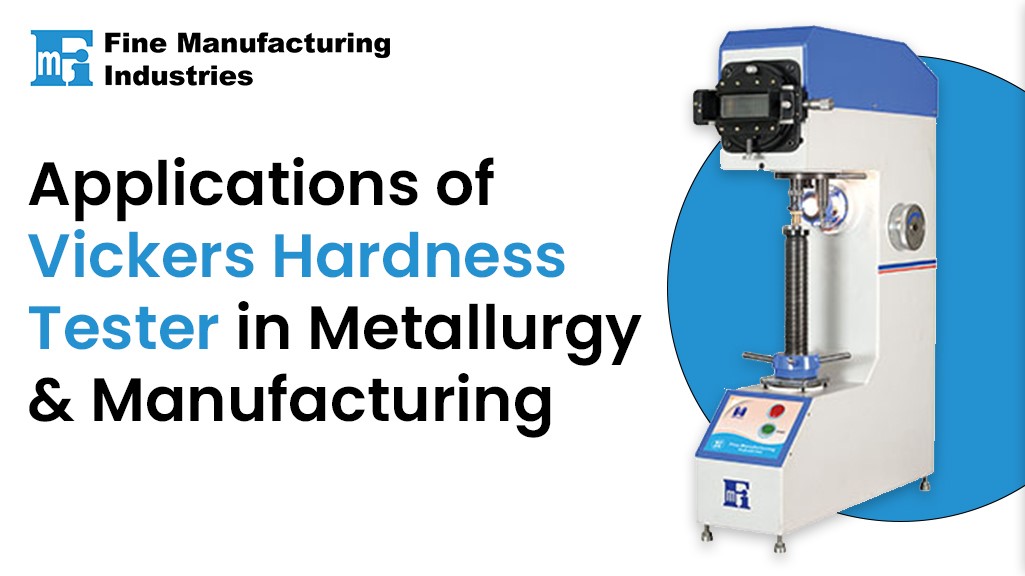
Applications of Vickers Hardness Tester in Metallurgy and Manufacturing
In today’s precision-driven industries, material quality plays a critical role in product performance and safety. The Vickers Hardness Tester is one of the most reliable tools used to measure material hardness, especially for metals and thin components.
From metallurgy labs to large-scale manufacturing units, this testing method ensures accurate quality control, durability, and consistency in materials.
What is a Vickers Hardness Tester?
A Vickers Hardness Tester is a material testing device that measures hardness by pressing a diamond-shaped indenter into the surface of a material under a specific load. The size of the indentation is then used to calculate the hardness value.
Why It’s Widely Used
- • Suitable for all metals and alloys
- • Works for both soft and hard materials
- • High accuracy for micro and macro testing
- • Ideal for thin materials and coatings
Importance of Hardness Testing in Metallurgy and Manufacturing
Hardness testing helps industries:
- • Ensure material strength and durability
- • Maintain product quality standards
- • Detect defects and inconsistencies
- • Improve manufacturing processes
The Vickers method stands out due to its versatility and precision.
Key Applications of Vickers Hardness Tester
1. Metallurgical Research and Development
In metallurgy, understanding material properties is essential. The Vickers Hardness Tester is widely used to:
- • Study microstructure of metals
- • Analyze phase changes
- • Evaluate heat treatment processes
It helps researchers develop stronger and more durable materials.
2. Quality Control in Manufacturing
Manufacturers rely on hardness testing to maintain consistent product quality.
Applications include:
- • Testing raw materials before production
- • Inspecting finished components
- • Ensuring compliance with industry standards
This ensures that every product meets required specifications.
3. Testing Thin Materials and Coatings
One of the biggest advantages of the Vickers method is its ability to test very thin materials.
Used for:
- • Surface coatings
- • Plated materials
- • Micro-components
This makes it ideal for industries like electronics and precision engineering.
4. Automotive Industry Applications
In automotive manufacturing, component strength is critical.
Vickers hardness testing is used for:
- • Engine parts
- • Gears and shafts
- • Brake components
It ensures parts can withstand stress and wear over time.
5. Aerospace Industry
The aerospace sector requires extremely high material reliability.
Applications include:
- • Testing aircraft components
- • Evaluating high-strength alloys
- • Ensuring safety and compliance
Even small defects can lead to failure, making accurate hardness testing essential.
6. Heat Treatment Verification
Heat treatment processes like hardening and tempering directly affect material properties.
The Vickers Hardness Tester helps:
- • Verify hardness after treatment
- • Ensure uniform results
- • Detect improper processing
7. Welding and Joint Analysis
Weld quality is crucial in manufacturing.
Hardness testing is used to:
- • Check weld strength
- • Analyze heat-affected zones (HAZ)
- • Detect weak joints
8. Tool and Die Industry
Tools and dies require high hardness for long service life.
Applications include:
- • Cutting tools
- • Molds and dies
- • Industrial equipment parts
This ensures durability and reduces wear.
Advantages of Vickers Hardness Tester
- • High precision and accuracy
- • Suitable for micro and macro hardness testing
- • Works on a wide range of materials
- • Minimal surface damage
- • Ideal for thin sections and coatings
Factors Affecting Test Accuracy
To get reliable results, consider:
- • Proper surface preparation
- • Correct load selection
- • Accurate measurement of indentation
- • Calibration of the machine
Conclusion
The Vickers Hardness Tester plays a vital role in both metallurgy and manufacturing industries. Its ability to provide accurate, reliable, and versatile hardness measurements makes it an essential tool for quality control and research.
From testing thin coatings to evaluating heavy industrial components, its applications are vast and critical for ensuring product performance and safety.
FAQ
It provides precise hardness measurement for studying material properties and microstructures.
Yes, it is ideal for thin materials and coatings due to its small indentation size.
Automotive, aerospace, metallurgy, manufacturing, and electronics industries.
Its diamond indenter and precise measurement method ensure high accuracy.